

The Rothschild Family
Ashton and The Rothschild Family
The Rothschild family have a long association with Ashton in Northamptonshire. Here we present some random facts and anecdotes, many doubtless apocryphal and/or erroneous!
How did the Rothschild family become owners of the Ashton Estate?
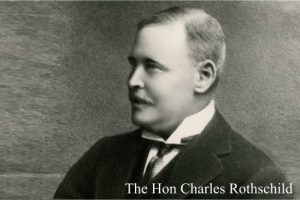
Charles Rothschild (1877 – 1923) was an enthusiastic Natural Historian, and Scientist and a Merchant Banker. By repute, Charles was one of the most brilliant members of the family – and perhaps more interested in science than in banking. The Hon Charles Rothschild was in particular passionate about insects – butterflies, moths, fleas and beetles (a passion inherited by his daughter, the Hon Miriam).
The Skipper, (located in Ashton, by the Village Green, www.chequeredskipper.co.uk), an inn built (to a design attributed to William Huckvale) for Charles Rothschild, at the time perhaps the world’s most famous financier, was concerned with more important matters, such as the purchase on behalf of Queen Victoria of the Suez Canal: “Madam you have it!”
Some claim the above anecdote about Ashton is rubbish, a puff-piece, and a family myth. Nevertheless, it seems true that Charles Rothschild’s interest in Ashton focused on the flora, fauna and natural beauty of the Estate.
Apparently Charles was enchanted by the Ashton Woodlands, with their abundant old sallow bushes and attendant Hair-streaks – rare butterflies whose larvae feed on ancient sallow. A variety of other butterflies inhabit these magical woodlands, including Fritillaries, and, allegedly, Purple Emperors. A Lepidopterist in possession of a good fortune is in need of a natural woodland, and Charles enquired of a local inn as to the owner of the Ashton Woodlands. The “Hon NCR” was dismayed to learn that the woods were owned by a family that (so it was said) rarely sells property and rarely needs to sell property. The aspiring silviculturalist and beetle enthusiast was less dismayed to learn that the family in question was the Rothschild family, and that the (indirect) owner was his father, Nathaniel Mayer Rothschild, (who had regarded the Ashton Estate as inconsequential and hardly worthy of note, despite the fact that the Estate then included significant areas of land now sold – alas, “how are the mighty fallen!”), and how erroneous are the comments of proprietors of local hostelries, with the exception of course of the proprietor of the Chequered Skipper.
The Skipper, (located in Ashton, by the Village Green, www.chequeredskipper.co.uk), an inn built (to a design attributed to William Huckvale) for Charles Rothschild, at the time perhaps the world’s most famous financier, was concerned with more important matters, such as the purchase on behalf of Queen Victoria of the Suez Canal: “Madam you have it!”
Some claim the above anecdote about Ashton is rubbish, a puff-piece, and a family myth. Nevertheless, it seems true that Charles Rothschild’s interest in Ashton focused on the flora, fauna and natural beauty of the Estate.
Bankers and Financiers, Artists and Scientists?
The Rothschild clan can be divided into those interested in banking and finance, and those interested in the arts and the sciences – with however many notable examples of overlap.
Perhaps regrettably, in terms of the physical fabric of the Ashton Estate, it is the scientific branch who have assumed the mantle of stewardship: and the scientists are not renowned for their financial prowess, or for their asset base. Among the arts and sciences branch, there has been a good run of “Firsts” from Oxford and Cambridge, and at the least – within the present generation – five first cousins who gained Oxbridge Firsts. Gaining only a “poor” First and the inability to obtain a PhD under the age of 23 seems to be the family definition of failure?! However, included amongst the members of the family with few academic qualifications are some of those with the most noteworthy academic and creative achievements. For example, the Hon Miriam (who lacked a university undergraduate degree) and the Hon Victor (who gained a rather modest degree) both became renowned scientists, and Victor and Miriam are believed to be the only brother and sister to be contemporaneous Fellows of the Royal Society.
“Fleas, Flukes and Cuckoos” and Other Parasites?
The Hon Nathaniel Charles Rothschild – the brilliant amateur scientist (1877-1923) – was very interested in fleas. Fleas are not only interesting but are also important – the Black Death (assuming it really was bubonic plague) was carried by bacteria within fleas (themselves carried on rats), and bubonic plague is still rife in certain parts of the globe. The modern day plague of Myxomatosis is carried by fleas – rabbit fleas – but transmission by this vector is restricted primarily to temperate climates. In places such as Australia, transmission is in general by another insect vector – the mosquito. The plague flea “Xenopsylla Cheopis Rothschild” is named after Charles Rothschild.
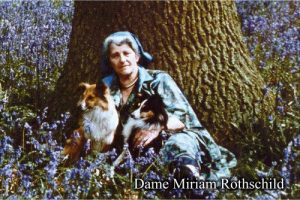
The Hon Dr Miriam (Charles’ daughter) became a parasitologist and, amongst other achievements, perhaps the world’s greatest expert on fleas – and the author of that magnum opus “The Rothschild Collection of Fleas”. The Hon Miriam wrote “Fleas Flukes and Cuckoos” for the New Naturalist Series, one of the most popular volumes in this very popular series. Each chapter begins with a witty or pithy quote, such as “has the king of Israel came out to seek a single flea” – Samuel 1, 26:20.
The Estate is owned by the Rothschild family who take a keen interest in the efficient running of the commercial operations whilst maintaining the long held family commitment to conserve the landscape and historic estate buildings.
In this video Dame Miriam Rothschild talks about herself and chooses seven of the things she finds most wonderful in nature as part of a BBC TV science series called ‘Seven Wonders of the World’, broadcast in 1995.
One newspaper seemed to enjoy lampooning the Rothschild family and entitled their article (on the collection of fleas from Russia) “Fleaing the Iron Curtain”. Another, paper of a more leftward leaning mien, had articles on “the real parasites”: the Rothschild’s themselves.
A few decades earlier, Lady Rothschild had, perhaps unwisely, embarked on litigation pursuant to her disappointment at the puppies born to her prize canine, giving rise to the obvious headline “Lord Rothschild’s Bitch in Court”.
Rothschild Humour and Anecdotes
Several members of the family have enjoyed a ready wit: however, a number of bon mots ascribed to the Rothschild’s, may not actually have been of their creation.
Books on and by the Rothschild’s: in the event of financial Armageddon, family members could doubtless enjoy gainful employment by writing about………. the Rothschild’s. A Google search reveals a vast number of books (even a musical) on, or by, the Rothschilds. One book that appeals to the OHL Ltd team is:-
“The Rothschild Gardens”, Authors: Miriam Rothschild, Kate Garton, Lionel de Rothschild. Photographed by: Lionel de Rothschild, Andrew Lawson. One chapter has an humorous and informative account of life on the Ashton Estate, during the heyday of the Estate. Lionel de Rothschild has noteworthy academic credentials and the chapter on Exbury is well worth a read.
Further information resources on the Rothschild family are as follows:-
Further information resources on the Rothschild family are as follows:-
- The Rothschild Archive: www.rothschildarchive org Much of the Archive is available on-line to everyone.
- The House of Rothschild by Niall Fergusson
- Rothschild Wines:
Chateau Lafite – www.lafite.com
Chateau Mouton Rothschild – www.mouton-rothschild.com - Waddesdon (The Waddesdon Manor Estate) –www.waddesdon.org.uk
- The Exbury Estate – www.exbury.co.uk